If you spend enough time researching gear for the West Coast Trail, you will inevitably stumble into the weeds of West Coast Trail Pack Weight and the “ultra-light” hiking community.
These are the astute, experienced hikers who debate the necessity of every single piece of gear. They possess a fascinating subculture of ounce-counting, where every item is pulled from a pile and placed on a digital kitchen scale measuring down to the fraction of an ounce.
To the uninitiated, entering this discussion is utterly confusing. But as a 51-year-old rookie desperately trying to figure out how to survive this trail, I became obsessed with their methods.
FAQ: What is the ideal West Coast Trail pack weight for a comfortable hike?
The ideal West Coast Trail pack weight typically ranges from 30 to 40 pounds, depending on your personal fitness level and the length of your trip. Focus on practical pack decisions by balancing gear weight, food weight, and water. Instead of chasing ultra-light hiking trends, prioritize comfort and accessibility to enjoy the stunning scenery.
Is a 40 lb pack too heavy for the West Coast Trail?
40 pounds is generally the upper limit of comfortable West Coast Trail pack weight. For most people, between 30 and 40 pounds is an ideal range for your pack weight that will make those grueling days in the forest and scrambling over the boulders of Owen Point MUCH more enjoyable!
What is the average pack weight for the West Coast Trail?
Most hikers will suggest that 35 pounds is an ideal West Coast Trail pack weight. Some “ultralight” hikers demand a 15 lb or 20 lb pack weight, and “comfort” hikers will often stretch their pack weight to 45 lb or even 50 lbs, but for the vast majority of people, striving to limit their west coast trail pack weight to 35 lbs is a perfect strategy.
The LighterPack Obsession
The holy grail for the obsessive planner is a free online tool called LighterPack. It allows hikers to list every single item they are carrying and generates beautiful, color-coded pie charts breaking down their “base weight.”
You can immediately see a hiker’s philosophy just by looking at their pie chart. A massive blue slice for a heavy tent means a “comfort” hiker. A sliver of a gray slice for a minimalist tarp means you are looking at a masochistic ultra-lighter who might literally run down the trail.
I spent hours scrolling through the meticulously planned gear lists of WCT veterans like Brett Marl (creator of the essential West Coast Trail App). I admired their technicolor Arc’teryx wardrobes and lusted after 5.1-ounce waterproof jackets.
But there was a massive disconnect between their digital spreadsheets and my physical reality.
The Hypocrisy of the Nameless Online Cart
When it came time to make my very first purchase—the backpack itself—I defied all common wisdom.
Most experts will tell you that a properly fitted backpack is the absolute difference between success and agonizing failure on a long hike. The fitting of a heavily weighted frame is a delicate science that requires the expert knowledge of a master pack-fitter at a specialty camping retailer.
The hypocrisy of my actual decision was astonishing: I had owned and operated a sporting goods store in Port Coquitlam almost single-handedly for twelve years. And yet, here I was, bypassing my friendly local neighborhood outfitter for the convenience of a nameless, faceless giant online retailer.
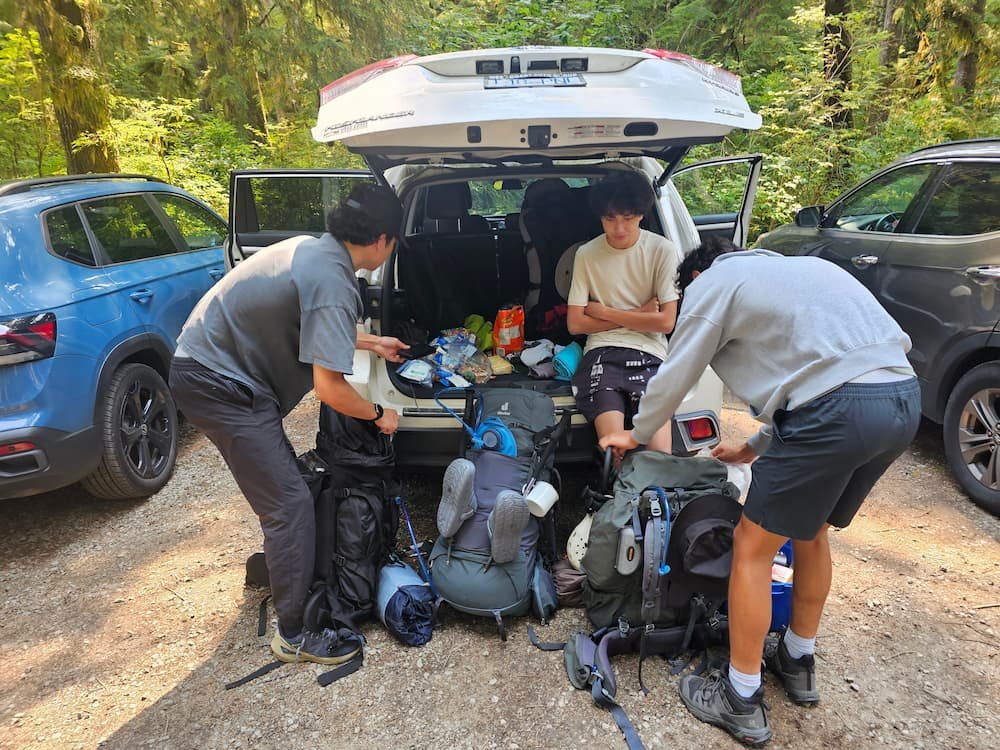
I was walking a tightrope, risking a seven-day nightmare with an ill-fitting pack. I sourced a very large Deuter pack with an extended torso length, clicked “Add to Cart,” and hoped for the best.
When the courier delivered the box, I eagerly unpacked it. By sheer dumb luck—and furiously yanking on whatever loose nylon I could find—I managed to utilize the pack’s “load lifter” straps just enough to keep the beast from pulling me over backward onto my living room floor.
Except, of course, for the absurd weight of the thing.
West Coast Trail Pack Weight: The 20% Rule vs. The 55-Pound Reality
When calculating your ideal West Coast Trail pack weight, experts advise that a loaded pack should only weigh 20% of your total body weight. For most average hikers, that would make your ideal west coast trail pack weight between 25 and 40 lbs. At 6’5″ and 230 pounds, my theoretical maximum was 46 pounds.
I stepped onto the trail carrying 55.
The irony was not lost on me. As I suffered in the forest, I encountered many poor souls who were clearly well outside their own recommended weight ranges, yet happily proceeding down the trail. My West Coast Trail pack weight may have been technically close to the limit for my large frame, but I clearly lacked the athleticism and cardiovascular strength to comfortably shoulder it.
By the time we reached Thrasher Cove that first night, the thud of my pack hitting the driftwood sounded like a bank vault slamming shut.
My shoulders were sore, but so were my knees, my thighs, my hips, my glutes, my toes, and my hands from my death grip on my hiking poles. Every single ache and pain was entirely self-inflicted, born of a blind click on the internet and nine pounds of extra regret.
The Takeaway for Normal People
If you are a middle-aged rookie, a bigger guy, or just someone who likes a few creature comforts, here is the honest truth about West Coast Trail pack weight:
- Ditch the Digital Scale: You are not an ultra-lighter. Stop stressing about matching a 22-year-old’s base weight. You are going to carry more food and heavier gear. Accept it.
- Do Not Buy Blindly Online: Go to a local outfitter. Put 40 pounds of sandbags into a pack and walk around the store for an hour. If I had done this, I would have saved myself days of agony.
- Invest in the Suspension, Not the Weight: When you are carrying a heavy load, a lightweight pack will destroy your shoulders. You need a pack with a world-class suspension system designed for heavy hauling.
Great backpacks for handling West Coast Trail pack weight include: Osprey Aether, Gregory Baltoro, or Deuter Aircontact. These packs are designed for the rigors of the trail: they all feature robust hip belts and frames that are built specifically to carry the 50+ pounds that normal hikers actually end up bringing.
While I am annoyed that I probably could have saved a couple of pounds, I am also entirely cognizant that I would have been infinitely more annoyed if I didn’t have the gear I needed. Salute the ounce-counters, but pack for the reality of your own body.
📖 The Book: 55 Pounds of Regret
Did I survive the 55-pound rookie mistake, or did I end up crying in a wet tent at Camper Bay? (Spoiler: It was a little bit of both).
I am currently putting the finishing touches on my upcoming memoir, 55 Pounds of Regret: Mud, Mutiny, and a Mid-Life Reckoning on the West Coast Trail.
If you want to read the hilarious, brutal, and honest story of a 51-year-old father surviving the mud, ladders, and teetering logs with his three sons, I am giving away the first three chapters for free.
👉 Click here to get the first 3 chapters sent directly to your inbox!