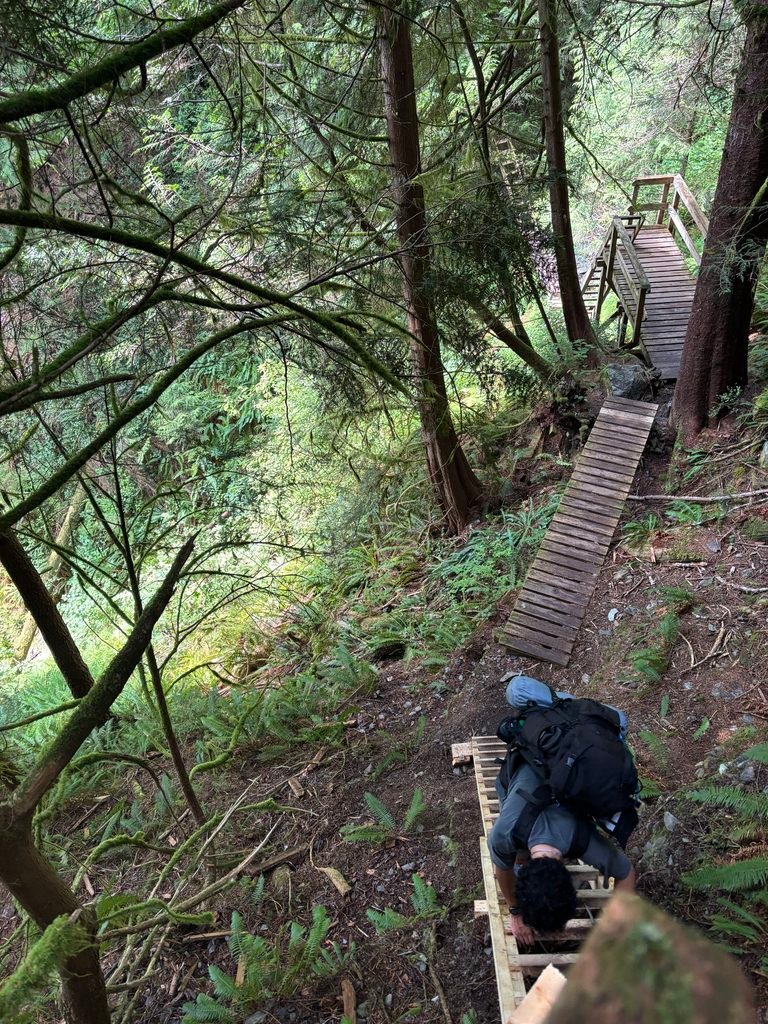
The “Evacuation Zone (Gordon River to Camper Bay): West Coast Trail Hardest Section
Parks Canada uses polite phrases like “challenging terrain” to describe the southern stretch of the West Coast Trail. The unvarnished reality is that the initial 22-kilometer push north from the Gordon River trailhead operates as an industrial meat grinder, responsible for a massive percentage of the 80 to 100 emergency evacuations that occur every single season. This is the West Coast Trail hardest section.
The Day-One Physiological Trap
The hike from Gordon River to Thrasher Cove (KM 75 to KM 70) looks like a trivial 5-kilometer stroll on the official map. In the real world, it is a relentless, root-choked obstacle course featuring over 400 meters of cumulative elevation gain and loss.
When you are in your fifties, carrying a 55-pound pack, and spending the entire morning trying to match the erratic, hummingbird-like pacing of your two sons, your legs will turn to absolute jelly by 3:00 PM. This systemic fatigue arrives at the exact moment the descents become the most severe. It is no coincidence that aggravated joint injuries—specifically blown knees and rolled ankles—are the leading cause of evacuations on this trail.
The Thrasher Cove Boundary: West Coast Trail Hardest Section
Hikers reach the Thrasher Cove junction early in the afternoon, look at their GPS, and experience a profound logistical panic. Realizing they have only covered 5 kilometers, their ego takes over, and they attempt to push through to Camper Bay (KM 62) to make up for lost time.
This is the exact mathematical error that summons a rescue helicopter. You must never push past Thrasher Cove on day one.
- The Terrain Penalty: The roughly 8 to 9-kilometer stretch between Thrasher and Camper Bay is brutally slow and technical.
- The Tide Trap: Attempting the beach route on exhausted legs guarantees you will be navigating the treacherous Owen Point boulder fields. These boulders are entirely impassable when the tide hits 1.8 meters, forcing exhausted hikers into high-risk scrambling.
- The Gravity Problem: Hitting near-vertical ladders and rotting wooden rungs with depleted glycogen reserves in fading evening light is how you fall backwards into the mud.
The Harsh Math of Rescue
If you miscalculate your fatigue and blow a meniscus descending into Camper Bay at 6:00 PM, you are not getting a swift, dramatic airlift back to civilization. Rescue helicopters do not fly in heavy coastal fog or darkness. Parks Canada explicitly warns that if you are injured in this zone, you must be prepared to wait upwards of 24 hours for help to actually reach you.
Surviving the Evacuation Zone is not about elite athleticism; it is about ego management. Pitch your tent at Thrasher Cove, accept the 5-kilometer day, and let your body adapt to the pack weight. The trail will still be there tomorrow, and you will actually have the intact cartilage required to hike it.