
Navigating the Owen Point West Coast Trail boulder fields is physically demanding. Navigating them while carrying a 55-pound backpack full of regret is an act of pure stubbornness. Here is how to survive the gauntlet.
Ask anyone who has hiked the southern end of the West Coast Trail about Owen Point, and you will get one of two reactions: wide-eyed awe over the sea caves, or a shudder remembering the soul-crushing boulder fields between Thrasher Cove and Camper Bay.
The shoreline route around Owen Point is easily one of the most dramatic, visually rewarding stretches of the entire 75 kilometres. It is also an unforgiving obstacle course where a simple misread of a tide table can leave you trapped against sandstone cliffs by incoming Pacific swell.
The Rule of the Tide Tables: Don’t Guess, Calculate
The inland bypass trail around Owen Point is notoriously muddy, root-choked, and punishing. The beach route is the preferred option—if the tides cooperate.
Parks Canada emphasizes this at orientation for good reason: rounding Owen Point requires a tide of 1.8 metres (6.0 feet) or lower.
- The Low Tide Window: Plan your departure from camp so you hit the point while the tide is falling or at dead low. Do not round it on an aggressively rising tide.
- Tide Station Reality Check: Ensure you are reading the Tofino (08615) tide charts. Even if you are starting in the south, Tofino is the baseline for all historical limits on the Parks Canada map. Using local stations like Port Renfrew can result in massive variances that will get you trapped at Owen Point.
- Surge Channels: Even if the tide height looks theoretically safe on paper, ocean swell and wind can push water higher up the shelves. Watch the sets roll in before stepping across narrow gaps.
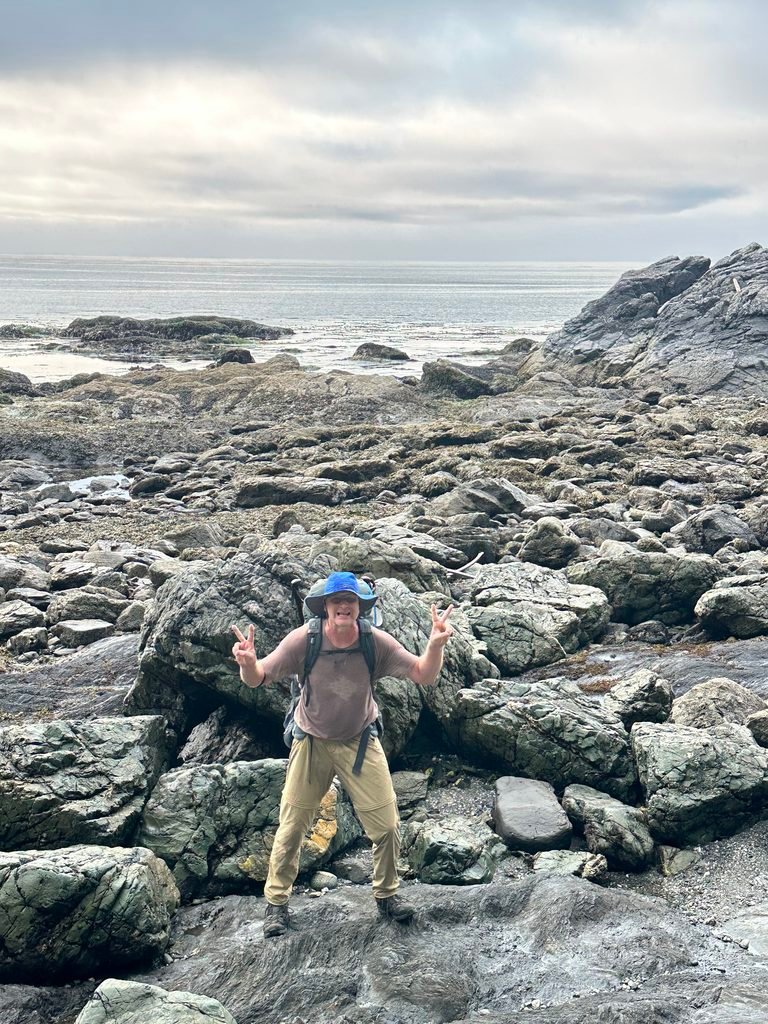
Owen Point West Coast Trail: Navigating the Boulders
Once you leave Thrasher Cove, the shoreline is not a stroll along packed sand. It is a labyrinth of car-sized, house-sized, and basketball-sized granite rocks dumped along the water’s edge.
| Hazard | What It Looks Like | How to Tackle It |
| Green Algae Shelves | Bright, slick sheen on smooth rock | Treat it like wet ice. Step only where barnacles provide traction; never trust bare rock. |
| Deep Boulder Crevasses | Gaps between massive granite blocks | Keep hands free of pole straps. A twisted knee or dropped pack down a slot ends the trip. |
| Log Jams at High-Water Marks | Piles of driftwood wedged into corners | Avoid balancing along unstable logs; route-find closer to firm rock shelves where safe. |
| Surge Gaps | Inlets cut deep into the shelf by waves | Wait for the wave retreat, move deliberately, and never jump under the momentum of a heavy pack. |

The Owen Point Sea Caves
When you hit the low tide window cleanly, the reward is extraordinary. Carved out by centuries of relentless wave action, the massive sandstone caverns at Owen Point West Coast Trail open up like natural cathedrals. Light reflects off tidal pools, sea anemones cling to the crevices, and the echoing roar of the ocean fills the cavern.
Take five minutes, drop the pack against dry rock, and take it in. You worked hard for those views.
The Golden Rules for Rounding the Point
- Stash the Trekking Poles: When scrambling over large, slick boulders, trekking poles often become trip hazards rather than balance aids. Collapse them and strap them to your pack so both hands are free for three points of contact.
- Watch Your Weight Distribution: Jumping across gaps with a 45-to-55-pound pack alters your center of gravity dramatically. Step down, step up, and avoid dynamic leaps.
- If in Doubt, Take the Inland Track: If bad weather creates heavy surf or your group is running behind schedule and missed the low tide window, swallow your pride and take the forest trail. It is muddy and steep, but it guarantees you won’t get pinned against a cliff face.
For a complete narrative of how a 51-year old dad and his 3 sons managed to clamber over the boulder field to reach Owen Point with only MINOR injuries, click here to read the first 3 chapters of my book, Fifty-Five Pounds of Regret, for free.
Owen Point will test your ankles, your grip, and your patience, but clearing that last boulder field and stepping onto the firm shelves toward Camper Bay is one of the most satisfying milestones on the entire West Coast Trail.
I survived the Owen Point gauntlet, but my knees have never forgiven me. To read the full, disastrous story of my 75-kilometer hike, join the waitlist for my upcoming book at 55poundsofregret.com.
UPDATE: The “Hive Mind” Consensus for Owen Point After publishing this guide, I asked the veterans in the West Coast Trail Facebook group how they managed this section. Their responses made me realize exactly why I struggled so much. If you want to avoid my fate, here are the three undisputed rules from the WCT community:
1) The 4×4 Method: Buy cheap gardening gloves. Put the poles away entirely, get your center of gravity low, and use a 3-point contact bear-crawl.
2) The Leap-Frog Strategy: If hiking in a group, let the front person find the route, then leap-frog each other so you always have multiple sets of eyes finding the safest footing.
3) The Cheat Code: If hiking Southbound, drop your heavy packs at the beach access, walk out to the caves empty-handed, and then double back to take the forest route!
“Tide Station Discrepancies: Ensure you are reading the Port Renfrew / Juan de Fuca tide charts, not Tofino or Bamfield. A half-metre variance can mean the difference between a dry rock shelf and waist-deep Pacific surf.”
This is absolutely incorrect. The correct station for ALL limits along the West Coast Trail is the Tofino (08615) station. This is stated clearly on the Parks Canada map and Tofino was used as the baseline for all tides along the trail for historical reasons.
Sometimes Port Renfrew is close, but other times is has some huge variance. Enough to get hikers into a LOT of trouble at Owen Pt.
Brett, thank you so much for catching this and correcting me. I have immediately updated the post. This is exactly why I leaned so heavily on your WCT App out there — left to my own devices, I am a walking hazard. Thanks for keeping the community (and my readers) safe!