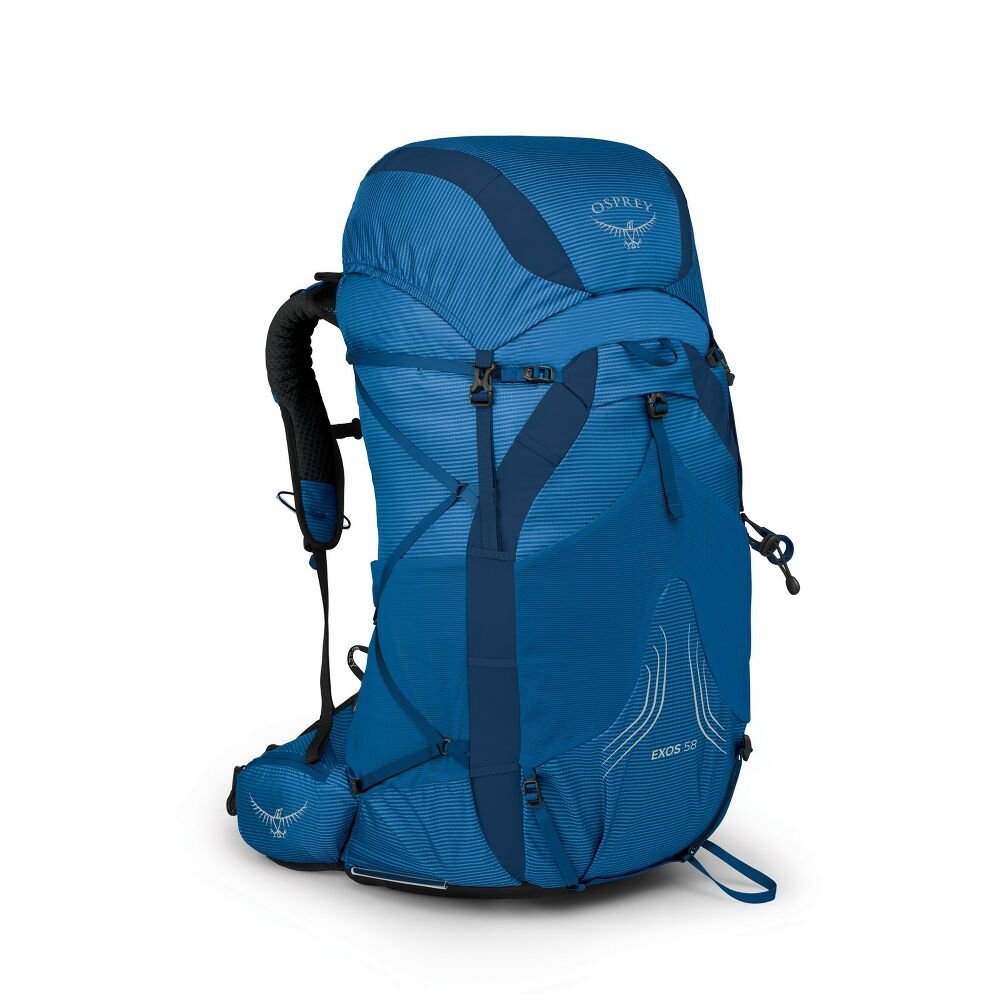
Osprey Exos 58 Review: What Happens When You Load an Ultralight Pack with 55 Pounds of Regret?
There is a golden rule in the ultralight backpacking community: you do not buy a 2.8-pound precision-engineered pack just to stuff it like a Thanksgiving turkey. The Osprey Exos 58 is built to float on your back, utilizing a trampoline-style mesh suspension system designed to comfortably carry a sweet spot of 30 to 35 pounds. Naturally, as a 51-year-old man attempting to outrun his mid-life reckoning, I ignored the math, weaponized my anxiety, and loaded it with 55 pounds of regret for an eight-day death march down the West Coast Trail.
I was hiking alongside my three teenage sons—a former junior hockey goalie turned marathon runner, and his equally explosive younger brothers. While they casually threw on my oversized hand-me-down Gore-Tex and packed with the invincible nonchalance of youth, I was neurotically weighing freeze-dried stroganoff on a kitchen scale and packing enough medical supplies to perform field surgery. I asked a minimalist, ultralight frame to carry a maximalist, middle-aged ego.
What followed on the 75-kilometer gauntlet of Vancouver Island mud bogs and 70-foot wooden ladders wasn’t just a test of Osprey’s legendary AirSpeed suspension. It was a masterclass in what happens when a piece of high-end gear is forced to absorb the sheer, punishing weight of a father’s refusal to accept that he is no longer the strongest guy on the trail.
The Damage Report (Specs vs. Reality):
- Pack Weight: 2.84 lbs
- Capacity: 58 Liters
- Osprey’s Recommended Load Range: 30–35 lbs
- My Actual Load: 55 lbs
The “AirSpeed” Suspension Under Extreme Duress
If you read the marketing materials, Osprey’s AirSpeed suspension is a marvel of modern engineering. It features a 3D-tensioned mesh back panel stretched across an ultralight aluminum perimeter frame. The design creates a literal trampoline between the backpack and your spine, allowing massive airflow and comfortably distributing a recommended 30 to 35-pound load.
But what happens when you crush that elegant mesh trampoline with 55 pounds of middle-aged anxiety, oversized Gore-Tex, and a pharmacy’s worth of Advil?
It fights for its life.
When you exceed the 35-pound threshold on a pack this light, the physics fundamentally shift. As we hit the notorious mud bogs just south of Michigan Creek, that airy gap between the pack and my back compressed entirely. The suspension didn’t fail or snap—which is a massive testament to Osprey’s build quality—but the tensioned mesh essentially bottomed out against the frame.
Every time I aggressively grabbed a rung on the 70-foot ladders, gravity yanking me backward, the Exos 58 felt less like it was floating on my hips and more like it was actively trying to rip my shoulders from their sockets. Because the pack’s minimalist hip belt lacks the heavy, rigid padding found on 80-liter haulers, that extra 20 pounds of regret had nowhere to go but straight down my spine and right into my newly-rehabbed hamstrings.
The bottom line? The AirSpeed suspension is brilliant. It conforms beautifully to the body and breathes like a dream—right up until you decide to betray it. If you stay within Osprey’s load limits, it feels like wearing nothing. If you load it like an insecure Alpha Dad trying to out-pack his teenagers, the suspension will survive, but your cartilage won’t.
Packing the Beast (Organization vs. Chaos)
The Osprey Exos 58 is fundamentally designed for minimalist efficiency. As expected from an ultralight design, organization is limited to the essentials: a massive front stretch-mesh pocket, two dual-access stretch mesh side pockets for water bottles, a removable top lid (the “brain”), and two zippered hipbelt pockets.
Packing an ultralight bag properly is an exercise in ruthless editing. But I wasn’t editing; I was hoarding. Here is how I managed to cram 55 pounds of heavy, anxiety-induced overkill into a 58-liter space:
- The Main Compartment (The Vault of Regret): Instead of a whisper-light quilt, I shoved in a full-sized synthetic sleeping bag, layers of thick fleece, and a completely unnecessary camp chair. On top of that went a week’s worth of hyper-calculated, heavy freeze-dried stroganoff.
- The Top Lid (The Pharmacy): The Exos features a floating, removable top lid with both top and under-lid zippered pockets. Osprey designed this for maps, a headlamp, and maybe a few energy bars. I used it to house enough heavy trauma bandages, blister tape, and Advil to run a triage tent.
- The Front Stretch Pocket (The Mud Catcher): This giant front pocket is brilliant for stashing wet layers on the go. In my case, it became the temporary holding zone for heavy, mud-caked gaiters and water filters that I didn’t want contaminating the dry vault inside. The stretch mesh held up miraculously well, even when stuffed to its absolute tearing point.
The Exos gives you exactly the pockets you need and nothing you don’t. The problem wasn’t a lack of organization—the problem was my refusal to accept that a 58-liter pack is not a U-Haul trailer.
Durability: Surviving the West Coast Trail
When you buy an ultralight pack, the first compromise is usually durability. To keep the weight under three pounds, Osprey built the main body of the Exos 58 out of 100-denier high-tenacity nylon ripstop, reinforced with a heavier 400-denier nylon in the high-wear areas. On paper, 100D nylon sounds terrifyingly thin when you are about to drag it through 75 kilometers of jagged coastal rocks, dense Vancouver Island brush, and abrasive sandstone.
Add 55 pounds of tension to that thin fabric, and I was convinced the pack was going to explode like a water balloon.
Yet, here is where the Exos 58 actually blew my mind.
The West Coast Trail does not care about your gear. At Thrasher Cove, blinded by exhaustion, I unbuckled my harness and let that 55-pound vault of regret drop dead-weight onto a pile of sharp, weathered driftwood. The 400D nylon base absorbed the impact and didn’t even scuff.
The real vulnerability on any ultralight pack is the exterior stretch mesh. Between squeezing under fallen old-growth blowdowns and scraping against the notoriously tight wooden ladders, the giant front mud-catcher pocket and the dual-access water bottle sleeves took a relentless beating. While you do have to be mindful—snagging a sharp branch will tear the mesh if you pull hard enough—my Exos emerged from the mud bogs completely intact.
It turns out that Osprey’s high-tenacity ripstop nylon is significantly tougher than my middle-aged cartilage. The pack survived the West Coast Trail with flying colors; my ego, on the other hand, was left in shreds.
The Verdict (Osprey Exos 58 Review): Who is this actually for?
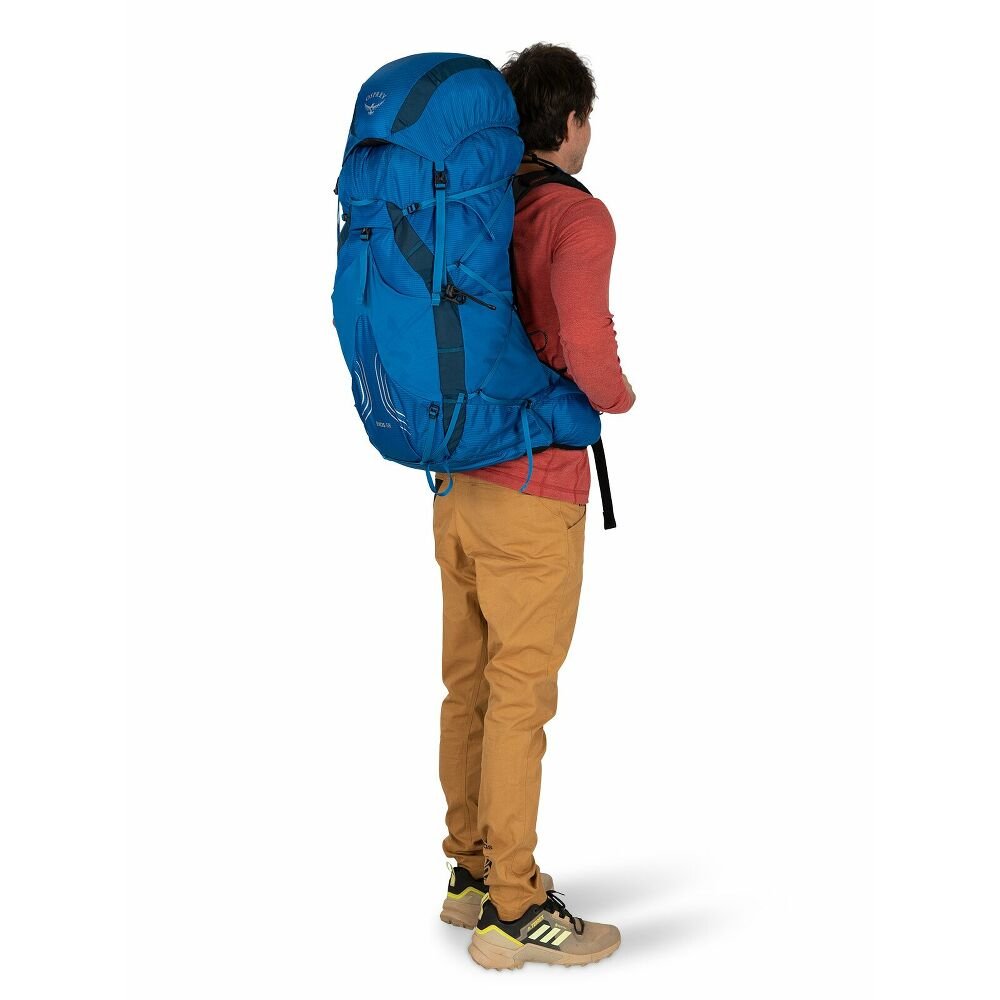
If you are a sane, rational backpacker who understands the assignment and keeps your total weight under 35 pounds, the Osprey Exos 58 is an absolute masterpiece. It strikes the perfect balance between ultralight minimalism and necessary comfort. At under three pounds, it will carry your kit for hundreds of miles while keeping your back incredibly cool and your load perfectly stable. It is one of the best thru-hiking packs on the market for a reason.
But if you are a stubborn, middle-aged father treating a wilderness hike like a tactical deployment, look elsewhere. If you plan to carry 55 pounds of excess gear, freeze-dried stroganoff, and ego, you need a heavy-duty hauler with a reinforced chassis—or better yet, you need to swallow your pride and make your teenage sons carry the tent.
The Exos 58 is an exceptional backpack; it just isn’t designed to carry the weight of a mid-life reckoning.
Check the current price of the Osprey Exos 58
Want to know exactly what was inside that 55-pound vault of regret, and how the rest of Day 1 on the West Coast Trail completely shattered my “Alpha Dad” illusion? The illusion died at the bottom of a 70-foot ladder, and you can read exactly how it happened.