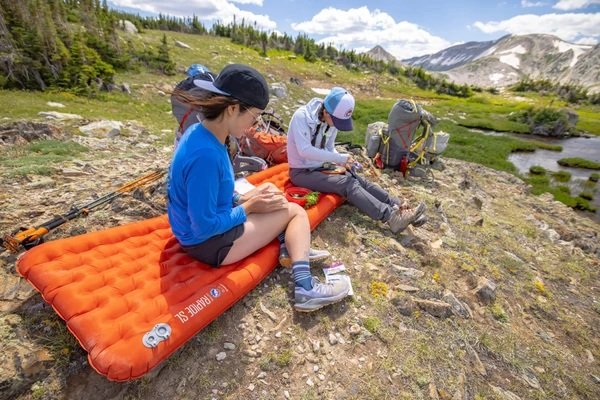
Big Agnes Rapide SL Insulated Review: The Backcountry Orthopedic Bed
1. The Thrasher Cove Triage
By the time I dropped my ridiculously overloaded 55-pound backpack at the Thrasher Cove campground on Day 1 of the West Coast Trail, my middle-aged joints were in full revolt. The ladders had destroyed my quads, the mud bogs had wrecked my ankles, and my spine felt like it was compressing in real-time.
I didn’t need a sleeping pad. I needed a backcountry orthopedic bed.
Ultralight backpackers will happily sleep on a 1/8-inch foam mat to save four ounces of base weight. I am not one of those people. Enter the Big Agnes Rapide SL Insulated. At 18 ounces (1 lb 2 oz), it is slightly heavier than the minimalist competition, but it boasts an absurd 4.25-inch outer baffle thickness and an R-value of 4.8.
It is, quite simply, a fortress of comfort. Here is why this pad was the only reason I survived the next seven days on the trail.
2. The 4.25-Inch Rails (Why you won’t slide off)
Most ultralight sleeping pads suffer from the same fatal flaw: if you shift your weight in the middle of the night, you roll off the edge and wake up on the roots of the forest floor. The Rapide SL solves this with its physical geometry. While the center of the pad is an already-luxurious 3.5 inches thick, the outer baffles are built out to 4.25 inches.
These raised rails act like a cradle, physically keeping you centered on the mattress even if you toss and turn on an uneven backcountry tent pad. For side-sleepers, that 3.5-inch center depth is critical. When your hips and shoulders dig into the pad, you will never bottom out against the hard earth, allowing your body to actually repair the micro-tears in your muscles before the next day’s grind.
3. The R-4.8 Sweet Spot: Thermodynamics on the Trail
Insulation matters just as much as cushioning. The West Coast Trail is notorious for bone-chilling coastal fog that rolls into camp, while the Jasper Skyline exposes you to freezing alpine winds. You lose heat to the ground infinitely faster than you lose it to the ambient air.
Big Agnes gave the Rapide SL an R-value of 4.8 using two layers of heat-reflective film and PrimaLoft Silver Insulation. To put that in perspective, here is where it sits on the backcountry survival scale:
| Sleeping Pad Category | R-Value | Temperature Comfort Range |
| Summer Only (Uninsulated) | 1.0 – 2.0 | Warm summer nights only (Above 10°C / 50°F) |
| Standard 3-Season | 2.0 – 4.0 | Spring to early Fall (Down to 0°C / 32°F) |
| Big Agnes Rapide SL | 4.8 | Extended 3-Season / WCT / Alpine (Down to -9°C / 15°F) |
| Winter Expedition | 5.5+ | Snow camping and extreme cold (Below -10°C / 14°F) |
4. The Pumphouse Ultra: Inflation Without Hyperventilating
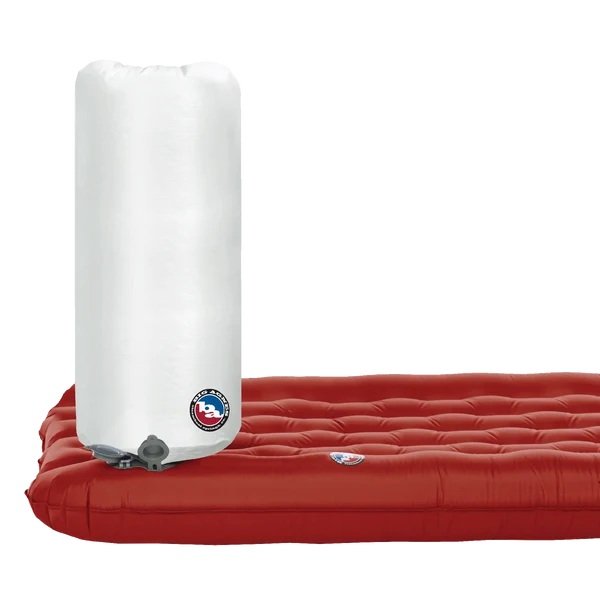
After hauling a 55-pound pack through 15 kilometers of mud bogs and ladders, the last thing your lungs want to do is blow up a massive air mattress. The Rapide SL includes the Pumphouse Ultra inflation sack to do the heavy lifting for you.
You simply snap the sack onto the pad’s one-way valve, catch a bag full of air, and roll it down to force the volume into the pad. It takes roughly eight to ten effortless pumps to inflate the entire mattress. More importantly, using the pump sack prevents the moisture from your breath from entering the pad. In damp environments like the WCT, blowing into a pad by mouth introduces condensation that will eventually grow mold inside the baffles and destroy the internal insulation.
5. The Silence: Escaping the Potato Chip Bag, the final verdict on the Big Agnes Rapide SL Insulated Review
If you have ever shared a shelter with someone sleeping on a Therm-a-Rest NeoAir, you know it sounds like they are wrestling a giant bag of potato chips every time they roll over.
The Rapide SL is completely silent. Big Agnes uses an aviation-grade TPU lamination technology and a quilted top fabric that eliminates the crinkling noise entirely. When you are exhausted and finally manage to fall asleep to the sound of the Pacific Ocean crashing against the shoreline, you won’t be woken up by the sound of your own gear.