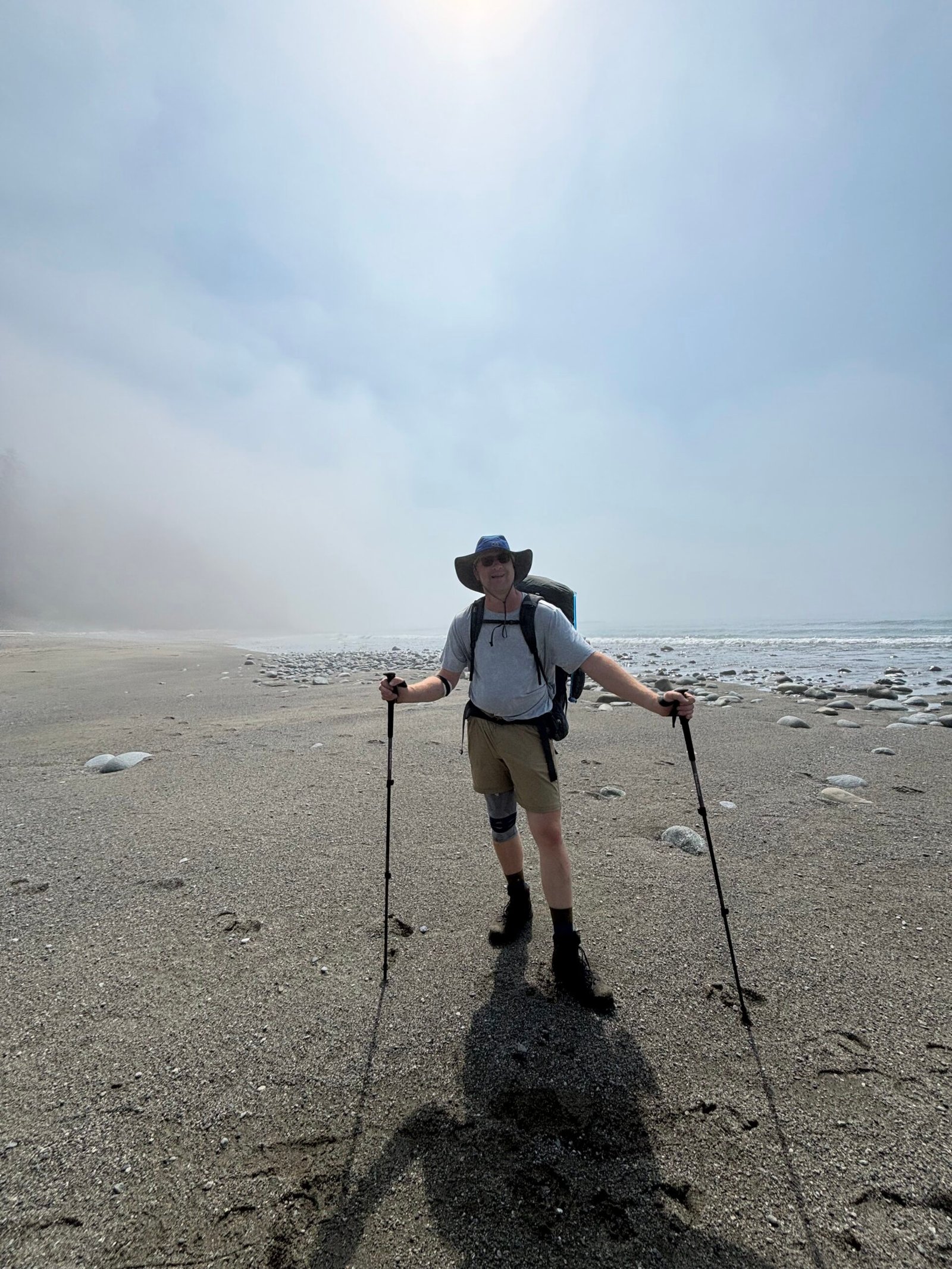
The Portrait of a 280-Pound Sloth
West Coast Trail Trekking Poles: Picture a 51-year-old man who is six-foot-five, weighs 230 pounds, possesses zero core strength, and is carrying a 50-pound pack. Now put him in the mud.
My gait is slow. And I don’t just mean slower than average. I mean that my progress is plodding on any level, athletic or not, old or young.
But as it turns out, that plodding gait provided a significant and unexpected advantage on a 75-kilometer hike through the Pacific Rim National Park. It allowed my brain to catch up with my feet and dictate the proper strategy for every single tortuous step. It was absolutely not instinct or muscle memory built from decades of athletic endeavor that allowed me to hike the West Coast Trail. It was the sheer micro-analysis of a hyper-focused visual system trained on the ground.
I was, however, aided in this journey by entirely artificial means. I wielded a pair of high-tech hiking poles as an absolutely critical method of achieving stability on virtually all of the terrain I encountered. By virtue of these artificial stick-legs, this two-legged Homo sapiens was transformed into a four-legged forest sloth.
The Physics of the Trail: Creating a 280-lb Lever System
There were massive segments of the trail, both in the forest and on the beach, that would have been incredibly difficult for me to traverse without my pair of trekking poles. My very first minutes in the forest on Day 1 provided a perfect case study.
The hiker immediately encounters a rapid ascent into the heart of the forest, followed by short descents, and then additional ascents, all within mere minutes. The slopes are coated in a slick, viscous coastal clay that offers zero friction. You must alternate between this clay and the occasional tree root platform to move up and down in elevation.
Particularly in the case of steep upward “steps,” such as those presented by a tall root structure, I found hiking poles to be absolutely essential. I was able to plant both poles deep in the soft dirt, then heave my body up and forward, leveraging the sticks to take a massive amount of my weight and momentum.
And by “massive,” I mean a really, really huge amount of force. Scientifically speaking, when a 280-pound mass (me plus my pack) accelerates upward and forward, it generates significant kinetic energy and downward mechanical stress. By planting my west coast trail trekking poles and pushing down on the grips, I was essentially creating a lever system. I transferred a large percentage of the compressive load away from my screaming knee joints and distributed it up through my arms, shoulders, and pectoral muscles, relying on upper-body torque to overcome gravity.
West Coast Trail Trekking Poles: Aluminum vs. Carbon Fiber: A Critical Warning
Picture those fully extended, three-section hiking poles bowed in the middle so dramatically that you wonder how they can possibly bend so much without snapping like twigs.
This is an incredibly important point. During my gear research, I was advised in no uncertain terms that it was 100% critical I purchase a pair of aluminum hiking poles instead of their increasingly popular brother, the carbon fiber pole.
The portrait of my weight and momentum threatening to bend my poles in half illustrates exactly why: quality aluminum hiking poles are ductile. They will bend, flex, and even permanently deform under extreme stress, but they rarely shatter. Carbon fiber poles, while significantly lighter and stiffer, are brittle under lateral stress. They are far more likely to snap cleanly in half when subjected to a sudden, acute sheer force.
Indeed, a member of our hiking family who weighs a fraction of what I do, Ella, actually broke one of her carbon poles halfway through our hike when it jammed between a couple of big rocks and failed to release.
There is absolutely, positively no doubt in my mind that had I chosen to cheap out and grab a pair of carbon poles at a big-box store for $49.99, I would have snapped them sheer in half within the first few minutes of Day 1. I would have had to carry the useless shards for seven full days and traverse the most difficult sections of the trail without any poles whatsoever. I paid a premium price for my Black Diamond aluminum west coast trail trekking poles, but they were the best functional upgrade of any of my gear.
When to Put the Poles Away (And When to “Air-Walk”)
As much as I relied on my aluminum crutches, the use of poles on the WCT is not universal. Hiking poles can potentially be a hindrance to quick progress—they obviously must be placed with every step, and they have a tendency to get stuck. My older son, Sean, whose trail gait was more like a bounding Sitka black-tailed deer than my four-legged sloth, often stowed his poles entirely when he ran ahead.
But even for the slow and plodding, there are specific sections where poles are actively discouraged.
The Boulders & Ladders
Poles will be of absolutely no assistance when traversing the famous boulder field directly south of Owen Point. In fact, poles are an enormous encumbrance there. They can prove incredibly dangerous if a hiker sustains a slip and lands awkwardly on a rigid shaft. For the boys and me, we simply stowed our poles in our packs or strapped them tightly out of the way so they wouldn’t catch on passing branches or scratch against large rocks.
Similarly, poles are a hazard on the ubiquitous ladder sections. We generally employed a strategy where we allowed the poles to hang loosely from their straps around our wrists, letting gravity hold them parallel to our bodies as we climbed up or down. A slight tug usually freed them if they occasionally caught on the dense salal bushes.
The Log Balance Beams
Finally, there are many sections of the forest where a single log rests—either laid purposefully by Trail Guardians or randomly felled by Mother Nature—necessitating the use of said log as a balance beam to pass high above a mud bog or a stream.
On a narrow log, there is simply no place to plant your poles. You must rely solely on balance. As a decidedly top-heavy man whose sense of balance makes him sway wildly left to right when his feet leave solid ground, encountering an elevated log gave me absolutely no purchase.
However, my poles still gave me the psychological confidence to make it across those dastardly tightropes. Picture this: a 6’5″ man proceeding slowly, step by agonizing step, with his arms straight out to his sides, gripping his hiking poles tightly in each hand, moving each pole in synchronization with his steps in MID-AIR!
Yes, dear reader, I was “air-walking” my poles across the length of logs up and down the WCT. I defy any hiker to tell me with any degree of honesty that they have ever borne witness to such a ridiculous sight. But I needed even the most absurd psychological crutch to help me across. And it worked! I never fell from a log into a deep gully even once.
Fun Fact: The Hollywood Ideal vs. The WCT Reality
For centuries, shepherds, pilgrims, and mountaineers used a single, heavy wooden staff (an alpenstock) for balance and defense. It wasn’t until the 1970s that European ski manufacturers began adapting lightweight ski poles for summer trekking, introducing the concept of dual-pole “Nordic walking” to distribute weight symmetrically.
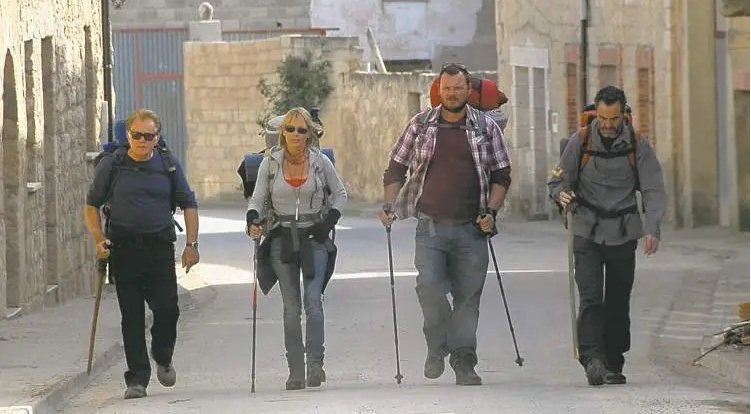
North America was slow to adopt this, and for decades, a single wooden walking stick remained the romantic ideal of the wilderness wanderer. Indeed, the films that inspired me before the WCT portrayed this exact aesthetic. Think of Martin Sheen’s character in The Way (2010), wielding a massively tall, prominent, gnarled branch as his hiking stick as he walked the Camino de Santiago.
I suppose Sheen’s wooden staff was symbolic of the heavy emotional burden he carried, but out here in the coastal clay, Hollywood romance will get you a broken ankle. Distribute the weight. Bring two poles.
The Final Verdict
My personal experience demonstrated a massive preference for a pair of high-quality aluminum poles, which were constantly and obviously beneficial to a man of my particular stature.
But for everybody else, please do your own research. Visualize your own body in the forest. Gauge your own level of athleticism. Picture yourself bounding through the forest happily, or perhaps slowly and ploddingly, as you hike your own hike and forge your own path in the most efficient and safest manner possible.
(Author’s Note: If you want to see exactly how these physical challenges broke me down—and how I ultimately survived them with my three sons—sign up for the mailing list to be notified when my upcoming book, 55 Pounds of Regret: Mud, Mutiny, and a Mid-Life Reckoning on the West Coast Trail, officially launches!)